Understanding SIA Centroid
Why Your Toric Calculator Might Be Wrong
1 What Happens at the Incision
A standard 2.2 mm temporal CCI flattens the cornea at the incision meridian.
- Flattening at 180° → steepening at 90° (with-the-rule astigmatism)
- But the exact amount and axis vary from eye to eye
- Wound healing, tissue elasticity, and geometry all differ
2 Measuring SIA: What You Get
SIA = Post-op K values − Pre-op K values
But SIA is a VECTOR — it has magnitude AND direction.
Axis convention: Astigmatism axes range from 0° to 180° only (not 360°). Diagrams below use 360° for visual clarity.
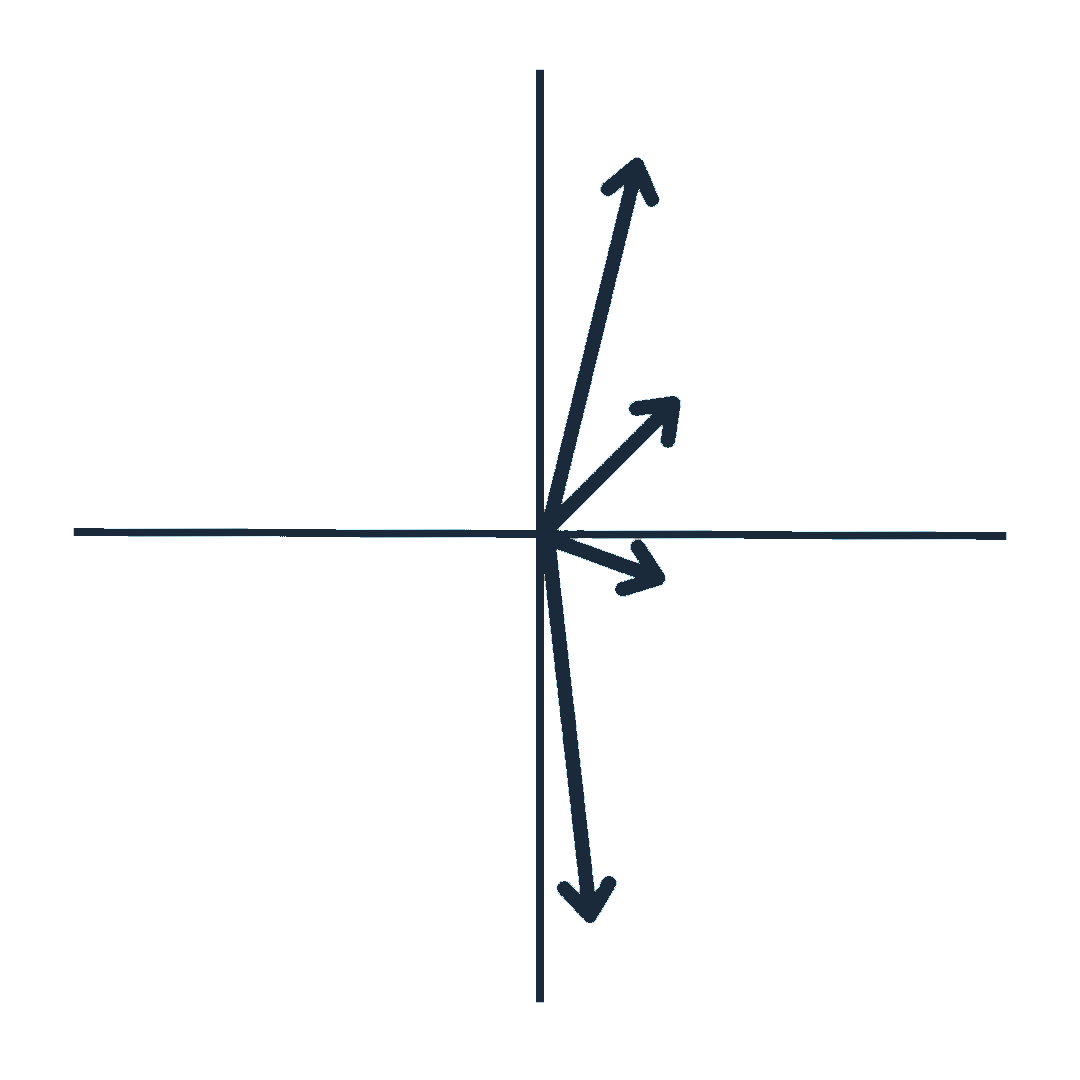
Four patients, same temporal incision:
| Patient | SIA Magnitude | SIA Axis | Comment |
|---|
| A | 0.40 D | 180° | Classic horizontal flattening |
| B | 0.30 D | 170° | Slightly off-axis |
| C | 0.50 D | 155° | Oblique — drifted 25° |
| D | 0.20 D | 85° | Perpendicular to incision! |
3 Arithmetic Mean vs. Centroid
Step 1: Four SIA vectors — different lengths, different directions
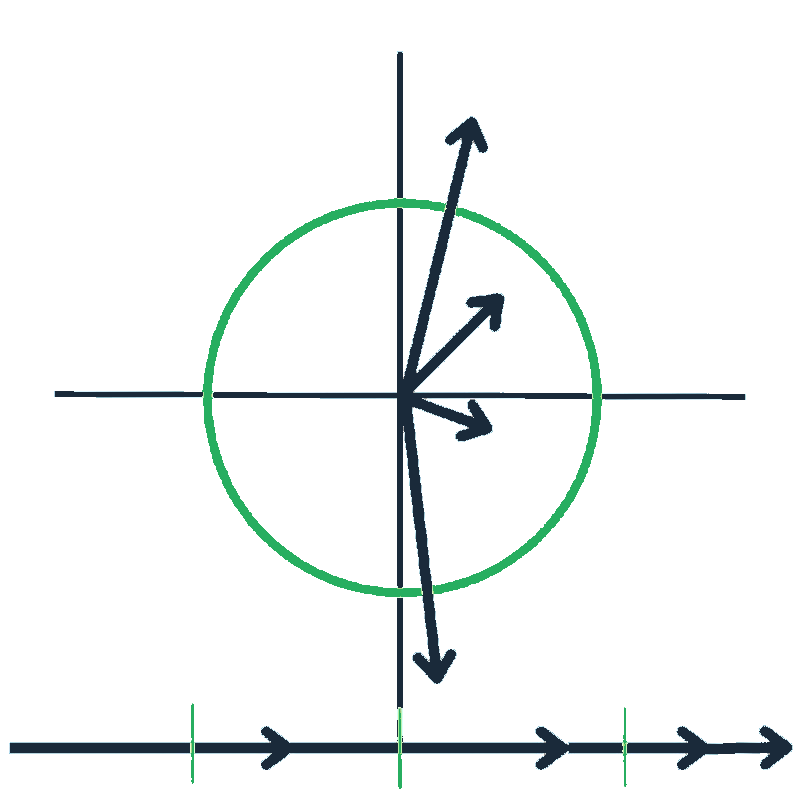
Step 2: The Mean (WRONG) — add lengths, divide by 4, ignore direction
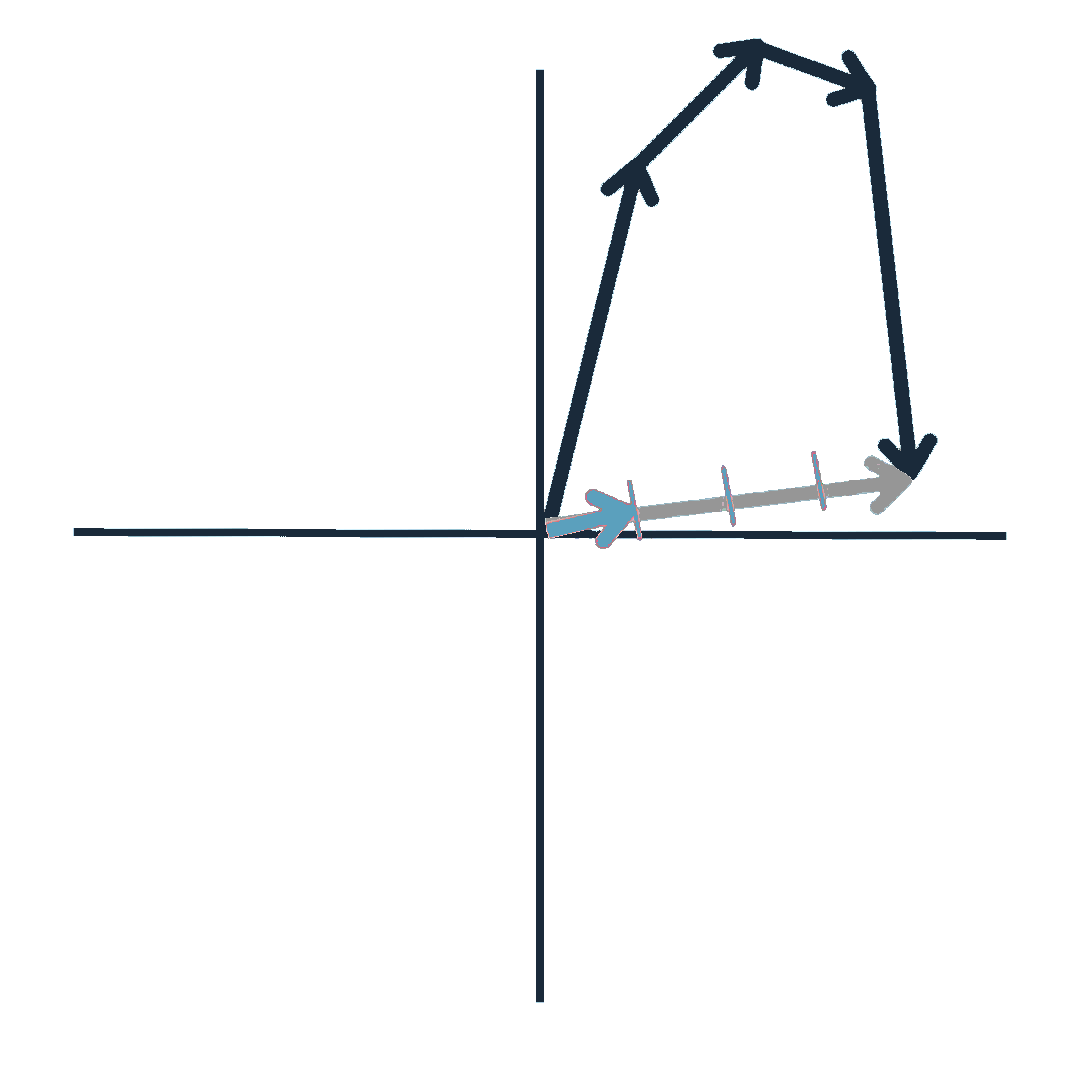
Step 3: The Centroid (CORRECT) — chain vectors head-to-tail, find resultant, divide by 4
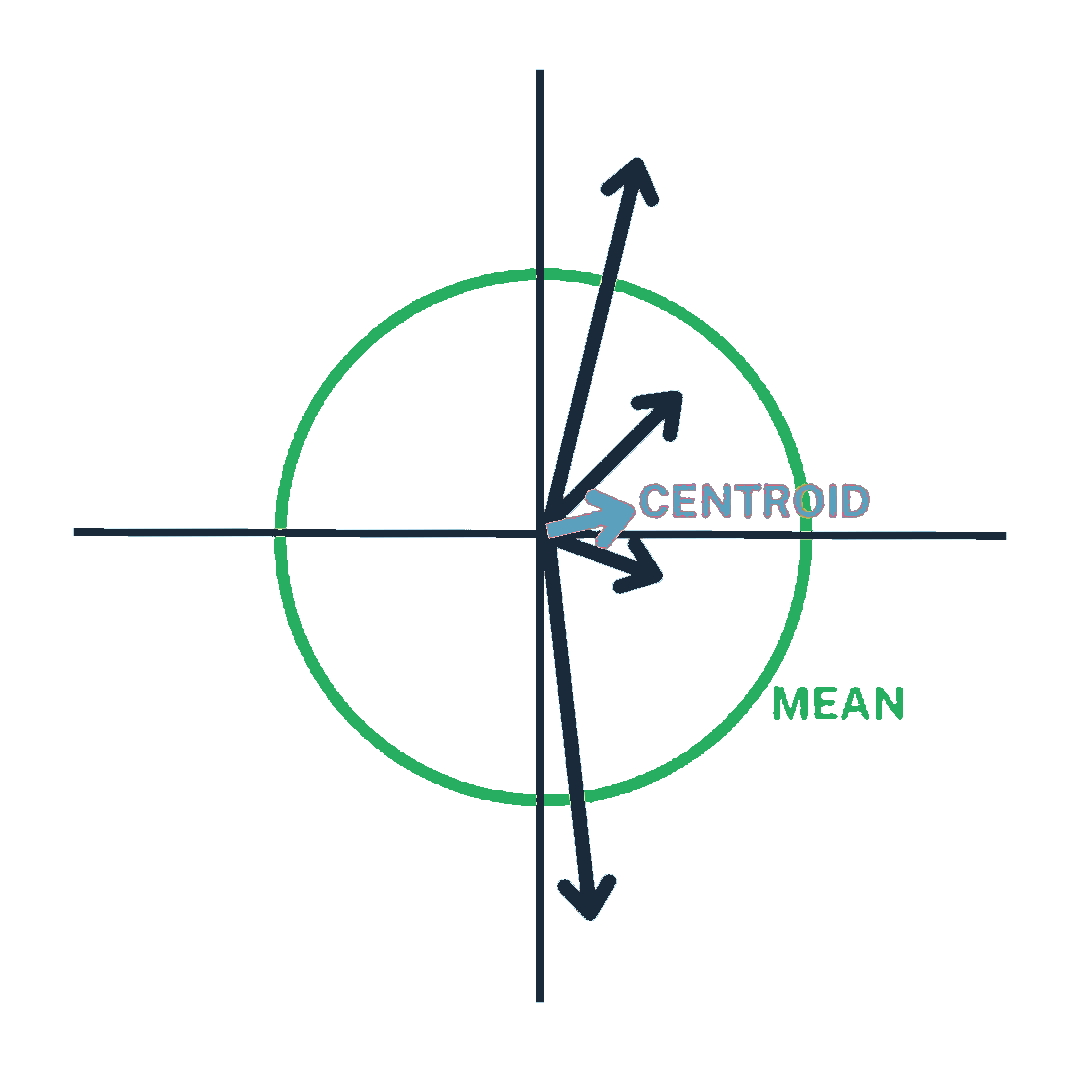
Step 4: The Comparison — Mean (green circle) vs. Centroid (blue arrow)
4 Beyond the Centroid — 3 Deeper Problems with SIA
(Wendelstein)
Problem 1: The Vector Mismatch
- SIA is a vector (magnitude + direction)
- But toric calculators only accept a single number — no axis input for SIA
- The calculator assumes SIA acts perpendicular to the incision meridian
- In reality, SIA direction varies from eye to eye
- This is a fundamental simplification that adds uncertainty
Problem 2: Surface ≠ Optics
- SIA is measured on the corneal SURFACE (via keratometry: pre-op vs post-op K)
- But the optical outcome depends on more than surface astigmatism — the crystalline lens is removed and replaced
- Corneal surface SIA may not equal the actual refractive change
- Measuring SIA via refraction would be more accurate but is unreliable in practice
- This means we’re correcting based on a measurement that may not reflect the true optical effect
Problem 3: The scatter is larger than the effect
- Wendelstein et al. (JCRS 2023, 498 eyes, superior incision):
Centroid SIA = 0.26–0.34 D, but SD = ±0.37–0.42 D
- The standard deviation is LARGER than the centroid itself. This means the scatter of individual measurements exceeds the systematic effect you’re trying to measure.
- For temporal incisions it’s even worse: centroid ~0.10 D vs SD ~0.40 D
- Consequence: personalizing your SIA risks OVERFITTING to noise
Side note: Some modern toric formulas (Barrett, EVO, Kane) use built-in regressions (e.g., Abulafia-Koch, Homburg-Adelaide) that account for SIA alongside many other factors — without requiring you to personalize it.
When the incision cuts the cornea, 3 things can happen:
- Only the magnitude of astigmatism changes
- Only the axis rotates
- Both change simultaneously
Effects 2 and 3 happen far more frequently than most surgeons assume.
Source: Wendelstein JR et al. "Characteristics of surgically induced astigmatism after standardized microincisional cataract surgery with a superior limbal incision." JCRS 2023;49(10):1025-1035.
5 Why This Matters for Toric IOL Calculation
Every toric calculator asks: "What is your SIA?"
If you enter 0.50 D (arithmetic mean):
- → Calculator thinks your incision RELIABLY induces 0.50 D
- → It reduces toric correction by 0.50 D at the incision meridian
- → But your incision does NOT reliably do this!
- → Result: You’re ADDING error, not removing it.
If you enter 0.10 D (centroid):
- → Calculator makes a tiny, accurate adjustment
- → Matches reality. Honest and correct.
6 What to Do in Practice
Enter 0.10 D (or zero) in your toric calculator.
- Barrett Toric Calculator already defaults to 0.10 D — trust it.
- If you want precision: calculate your personal centroid from ≥50 cases.
- Do NOT use the arithmetic mean of your SIA measurements.
Formula for centroid:
x = magnitude × cos(2 × axis) → average all x values
y = magnitude × sin(2 × axis) → average all y values
Centroid magnitude = √(x̄² + ȳ²)
7 The Punchline
"The biggest SIA mistake isn't not measuring it.
It's measuring it wrong — using the mean instead of the centroid —
and confidently entering the wrong number."
★ Quick Reference
| Concept | Value | Use it? |
|---|
| Arithmetic mean SIA | ~0.30–0.50 D | NO — ignores direction |
| Centroid (vector mean) | ~0.05–0.15 D | YES — true systematic effect |
| Barrett Toric default | 0.10 D | YES — evidence-based |
| If unsure, enter | 0.10 D (or 0) | YES — better than guessing high |
Prepared for Dr. Lorenz Kuske · April 2026 · learnabouteyes.com
Sources: Wendelstein et al., JCRS 2023; Koch DD et al., JCRS 2012; Barrett Toric Calculator; Lahood CRSToday 2023